Overview
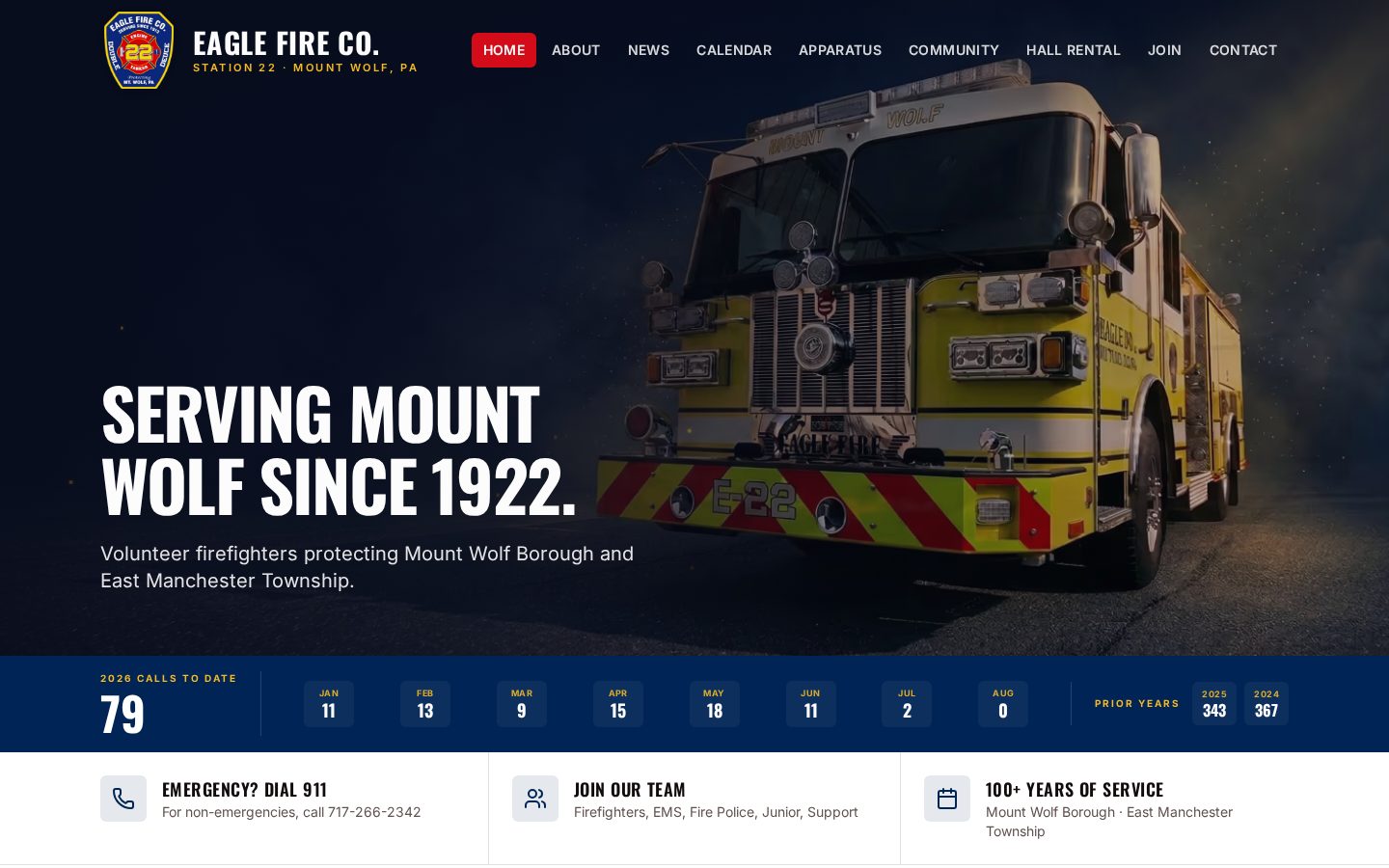
Eagle Fire Company is a volunteer fire department serving a community in York County, Pennsylvania. eaglefire22.com was designed, built, and launched in less than two weeks using AI-assisted development — and it does two jobs at once: it tells the community what they need to know, and it gives the volunteers behind it tools that save real time every week.
The problem
Volunteer departments run on donated hours. Every hour spent chasing paperwork is an hour not spent training, responding, or recruiting. The department faced the same constraints almost every small local organization does:
- No webmaster on staff, and no appetite for a monthly service contract just to post news.
- Quotes for a real website with member tools landed in five-figure territory.
- Hall rentals, membership applications, and event sign-ups were handled by phone, paper, and email threads.
- Institutional knowledge lived with whoever happened to be holding the folder.
“We know what we need. We just can’t justify a five-figure build and a monthly contract to get it.”
The approach
Rather than treating the public website and the internal tooling as two separate projects, we built them as one system with a login line down the middle.
One build, two audiences
The public side informs residents; the member side does work. Same platform, same data, one thing to maintain.
Iterate in hours, not months
AI-assisted development compressed the feedback loop, so members reviewed working screens instead of mockups.
Shaped by the people using it
Every module came out of a real complaint about how something currently gets done.
Owned by the department
Content, permissions, records, and exports all belong to Eagle Fire Company — not to a vendor.
What the public sees
News and announcements
A visual editor lets members publish stories with cover photos, galleries, and rich formatting — no developer required.
Events and calendar
Recurring events, featured highlights, and a navigable monthly calendar that automatically hides events once they've passed.
Incident counter
Year-to-date and monthly call volume, updated by the department and shown right on the home page.
Community resources
Knox Box information, smoke and CO detector inspections, hall rental details, and fire safety education for every age group.
What members get
Behind the member login sits the part of the site the public never sees — the tools that actually save the department time each week. This is where the project stops being a website and starts being software.
Role-based member login
Admins grant view or edit access module by module, so each member only sees the tools they need.
Internal event calendar
Drills, meetings, and details with optional sign-up sheets and automated 7-day and 24-hour reminders.
Hall rental management
Availability blocks, rental requests, digital agreement templates, and e-signature capture.
Submissions and applications
Contact messages and membership applications land in one inbox and are marked read as they're handled.
Audit logging
Every meaningful action is recorded for six months and can be filtered and exported to CSV or PDF.
Performance and media handling
Uploaded photos are automatically resized, converted to modern formats, and cached for fast loads on any connection.
The department published a full breakdown of the build on their own site: How This Site Was Built.
Impact
- Rental inquiries, agreements, and signatures now live in one place instead of a phone log and a filing cabinet.
- Event sign-ups and automated reminders replaced reminder phone calls and group texts.
- Membership applications and contact messages get tracked to completion rather than getting lost in a shared inbox.
- Six months of audit history means the department can answer “who changed what, when” without guessing.
- No webmaster, no service contract — members publish and administer everything themselves.
Cost and ongoing support
Instead of a five-figure build plus a monthly maintenance contract, Eagle Fire Company pays one yearly invoice and gets everything they need to keep the site running and improving.
$995 yearly invoice
One predictable payment covers the domain, hosting, and platform.
10 hours of updates & support
Included time for seasonal changes, new features, and member questions.
Call or text a real person
Need a change or have a question? Reach us directly — no ticket queue, no waiting on a vendor who stopped answering after launch.
What this means for your organization
Eagle Fire Company isn't a special case; it's a pattern. Most small organizations — municipalities, nonprofits, churches, trade shops — are running critical processes on paper, spreadsheets, and email threads because purpose-built software has historically been too expensive to justify. That math has changed.
- Replacing paper-and-email processes with a simple internal tool your team actually opens.
- Combining a public-facing site and an internal portal so there's one system to maintain, not three.
- Role-based access, audit trails, and exportable records where accountability matters.
- Shipping in weeks, on a budget a volunteer organization or small business can approve.